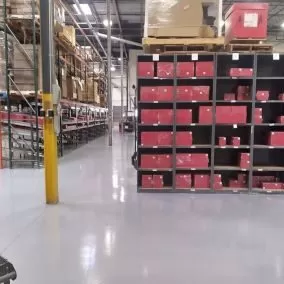
Logistics hubs run on precision. Inventory moves through receiving, sortation, storage, and dispatch with minimal margin for error or delay. In that environment, the floor is not just a surface to walk on. It's an active part of the operational infrastructure. Warehouse epoxy flooring supports logistics precision by providing a reliable, safe, and easy-to-navigate surface that never becomes the source of a problem.
How Does Flooring Affect Logistics Efficiency?
The connection between floor quality and logistics efficiency is more direct than most people initially recognize. A floor with surface irregularities, dust accumulation, or damaged joints slows forklift movement and increases equipment maintenance costs from the vibration transmitted through rough surfaces. A floor without proper line marking creates confusion in high-throughput picking environments. A slippery floor forces workers to move more cautiously than necessary, adding seconds to every movement cycle.
At scale, those incremental inefficiencies compound significantly. A logistics hub processing a million units per month loses measurable throughput if floor conditions are adding even a few seconds per movement cycle. Conversely, a clean, well-marked, smooth-but-grippy epoxy surface creates the ideal physical environment for efficient logistics operations.
What Specific Floor Properties Do Logistics Hubs Need?
Logistics hubs have specific requirements that differ somewhat from pure storage warehouses. High-frequency forklift and hand cart movement across large floor areas demands consistent surface texture and anti-slip performance throughout, not just in isolated zones. The sorting and picking environment needs excellent floor-level visibility from both the epoxy's light reflectivity and clear, durable floor marking.
Battery charging areas for electric forklifts need chemical-resistant surfaces that handle electrolyte spills without degradation. Dock areas need high-build coatings that resist the combined impact and chemical exposure of the loading interface. Restroom and break facilities need seamless, hygienic surfaces. A well-specified warehouse epoxy flooring system addresses every one of these requirements through zone-appropriate specifications.
Why Is Forklift Traffic Resistance So Central to Logistics Flooring?
In an active logistics hub, forklifts are essentially the circulatory system of the operation. Reach trucks, counterbalance forklifts, and order pickers travel enormous cumulative distances across the floor every day. The concentrated load under each wheel, multiplied by the frequency of passages, subjects the floor surface to extraordinary cumulative wear.
High Performance Systems engineers their warehouse flooring systems specifically for heavy-duty forklift traffic resistance. That engineering specificity matters because a floor coating that handles light commercial use fails quickly under true logistics hub conditions. The combination of high-solids resins, appropriate film thickness, and mechanically prepared concrete substrate creates a system that handles continuous industrial forklift traffic without developing the tire-track wear and edge delamination that cheaper systems show.
What Is the Role of Dust-Proofing in Logistics Operations?
Concrete dust in a logistics hub creates problems that compound through the operation. Product contamination from airborne concrete particles affects quality standards, especially in consumer goods distribution. Concrete dust accumulates in forklift wheel bearings and conveyor components, accelerating equipment wear. It settles on scanning equipment and sensors, creating read failures in automated systems. It coats racking components, making inspection of storage locations harder.
Sealing the concrete with industrial epoxy eliminates the source of that dust entirely. High Performance Systems has been dust-proofing concrete floors since 1988, a specific expertise that directly addresses the logistics industry's quality and equipment maintenance concerns. For operations running automated picking systems, that dust elimination supports equipment reliability in ways that translate directly into throughput performance.
A Scenario: Upgrading a Legacy Logistics Hub Floor
Picture a 10-year-old Central New Jersey logistics hub that was originally built with basic sealed concrete. A decade of heavy forklift traffic has worn through the original sealer in the main traffic lanes, leaving exposed concrete that dusts constantly. Joint fillers have deteriorated, creating edge chips that vibrate forklifts and slow travel speeds in affected aisles.
After a comprehensive epoxy installation that addresses the main floor with a high-build system, replaces deteriorated joint fillers with semi-rigid polyurea, and treats dock areas with an upgraded specification, the operational improvements are immediate and measurable. Forklift travel speeds normalize, dust complaints disappear, and the facility's next equipment maintenance cycle shows reduced bearing wear from the elimination of abrasive concrete dust exposure.
How Are Logistics Hub Floor Markings Integrated Into Epoxy Systems?
Floor marking in logistics operations is a critical safety and organizational tool. Aisle boundaries, pedestrian crossing zones, hazard areas, equipment staging areas, and emergency exit paths all depend on clearly visible, durable floor markings. On concrete, painted markings fade quickly under forklift tire abrasion and cleaning chemical exposure, requiring frequent repainting.
Epoxy-integrated floor markings are significantly more durable. Applied as colored epoxy or polyaspartic coatings and then covered with the topcoat layer, inlaid markings maintain their visibility and edge definition for years rather than months. The entire integrated floor system, coating and markings together, wears as a unit rather than having markings degrade while the surrounding floor remains intact.
What Is the Realistic Timeline for a Logistics Hub Flooring Project?
Planning a logistics hub flooring project requires realistic timeline expectations that account for the phased approach needed to maintain operational continuity. Pre-installation assessment typically takes one to two days for a thorough evaluation. Surface preparation and coating installation in a large facility typically proceeds at a rate of 5,000 to 15,000 square feet per day depending on system complexity and crew size.
A 100,000-square-foot facility done in phases might require two to four weeks from start to completion, with operational zones rotating through work and cure cycles. Experienced contractors develop phasing schedules that work around peak operational periods, weekend installation when possible, and cure time management that minimizes the calendar impact on facility throughput.
Conclusion
Warehouse epoxy flooring for logistics hubs is a system-level investment in operational performance. Every feature of a properly engineered epoxy system, from forklift traffic resistance to dust elimination, light reflectivity, and durable integrated markings, contributes directly to the efficiency, safety, and reliability that logistics operations demand. Working with contractors who understand both the technical requirements and the operational context delivers results that generic flooring approaches can never match.